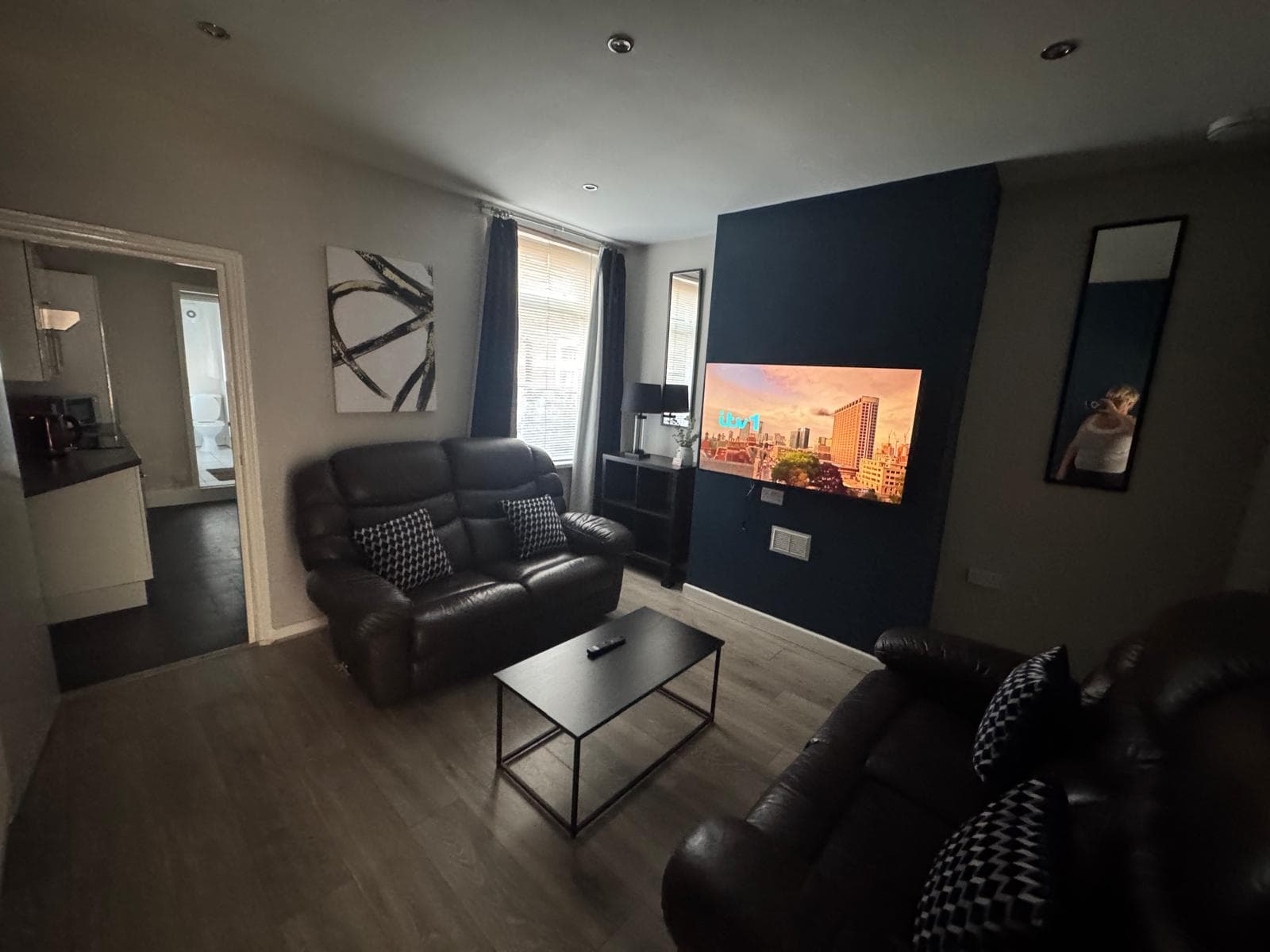
An HMO, or House in Multiple Occupation, is a property rented by three or more people who are not from a single household and who share a kitchen or a bathroom. Almost every shared student house in Stoke-on-Trent is an HMO. The larger ones need a licence from the council, and that licence brings safety rules with it.
Students tend to hear HMO and assume it is landlord paperwork that has nothing to do with them. It is the opposite. The licence is the mechanism by which somebody outside the tenancy checks that the house you are about to live in is safe for the number of people going into it, and it gives you something to point at if it is not.
Which houses need a licence
Mandatory HMO licensing in England applies to any property let to five or more people forming two or more households, sharing a kitchen, bathroom or toilet. There used to be a rule about the number of storeys. It was removed in October 2018, so a five-person let on a single floor needs a licence just as a five-person let over three floors does. The government HMO licence page is the definitive summary and lets you find your own council from a postcode.
Below five people, it depends on where the house is. Councils can run additional licensing schemes covering smaller HMOs, and selective licensing schemes covering ordinary lettings, in areas where they have decided the private rented sector needs closer attention. These vary by council and by ward, and they change. If you are looking at a three or four person house, the honest answer is that you have to ask the council rather than assume either way.
What a licence actually requires
To be licensed, a house has to satisfy the council on several fronts at once. This is the part worth understanding, because each item is a thing you can check on a viewing.
The manager has to be a fit and proper person. The council looks at the landlord or agent named on the licence, including any relevant convictions and any previous breaches of housing law. A licence is granted to a named person for a named property, not to a house in the abstract.
There have to be enough amenities for the number of people. Kitchen space, cooking facilities, sinks, bathrooms and toilets are all assessed against the number of occupants. This is the rule that stops six people being put into a house with one bathroom and a two-ring hob.
Rooms have to meet minimum sizes. Since October 2018 a mandatory licence carries national minimum room sizes for sleeping accommodation: 6.51 square metres for one person over ten, and 10.22 square metres for two people over ten. Floor space where the ceiling is below 1.5 metres does not count towards it. If a room is smaller than that, it cannot lawfully be used as a bedroom in a licensed HMO.
Fire safety has to be proportionate to the size of the house. Larger and taller HMOs generally need more: interlinked alarms, fire doors on to the escape route, emergency lighting, and clear signage. What is required depends on the property, and the council sets it as a condition of the licence.
The three certificates that matter
Whether or not a house is licensed, a landlord in England has to be able to produce these. They are not optional, and asking for them is completely normal:
- A Gas Safety Record, renewed annually by a Gas Safe registered engineer, covering every gas appliance and flue. You are entitled to a copy at the start of the tenancy. The government sets this out under landlord safety responsibilities.
- An Electrical Installation Condition Report (EICR), renewed at least every five years, with any category 1 or 2 faults put right. The 2020 electrical safety regulations require a copy to go to tenants.
- An Energy Performance Certificate (EPC) of band E or better. A property below band E generally cannot be let at all without a registered exemption.
Alarms sit alongside these. Since October 2022 there has to be at least one smoke alarm on every storey used as living accommodation, and a carbon monoxide alarm in any room with a fixed combustion appliance other than a gas cooker. A landlord also has to check they work on the first day of a new tenancy.
How to check a house is licensed
There are three ways, and it is worth using more than one:
- Ask the landlord. A licensed landlord will show you the licence without hesitating, and most will offer before you ask. Hesitation is information.
- Check the council register. Every council in England keeps a public register of licensed HMOs. Stoke-on-Trent City Council maintains one, and you can reach the right department from the government HMO page by entering the postcode.
- Look at the licence itself. It names the property, the licence holder, the expiry date, and crucially the maximum number of people and households permitted. If the licence says five and six of you are moving in, that is a problem you want to know about now.
What to look for on a viewing
You do not need to be an inspector. Five minutes of looking tells you most of what you need:
- Smoke alarms on every floor, including the hallway and the landing. Look up.
- A clear escape route from every bedroom to the front door, not blocked by furniture, bikes or storage.
- Fire doors on the rooms opening on to that route in a larger house: heavier than a normal door, usually with a self-closer at the top.
- A carbon monoxide alarm near the boiler.
- Bedrooms that are plainly big enough, particularly the smallest one. If a room looks close to the 6.51 square metre floor, ask.
- Enough bathroom and kitchen capacity for the number of bedrooms, not for the number of people who happen to be there on the day.
- Windows that open, and window keys that exist.
Ask who you call when something breaks, and how quickly they come. Renting direct from the landlord makes that answer shorter, because you are asking the person who is actually responsible for the house rather than a call centre that has to pass it on.
If something is wrong
Report it to the landlord first, in writing, so there is a record and a date. Most problems are fixed at that point and go no further.
If it is not fixed, or if the house is unlicensed, the environmental health team at Stoke-on-Trent City Council is the next step. Councils have real powers here: improvement notices, prohibition orders, civil penalties, and prosecution. They also assess hazards under the Housing Health and Safety Rating System, which covers everything from damp and cold through to fire risk and falls.
Two things worth knowing. Reporting a genuine hazard is protected: a landlord cannot lawfully evict you for it under retaliatory eviction rules. And if the house should have been licensed and was not, a rent repayment order can return up to twelve months of rent to the tenants who paid it.
Why this matters more in a student city
Student housing concentrates exactly the conditions that make HMO rules necessary. Houses built for one family are let to five or six unrelated people. Everybody cooks at different times. Everybody is out at different hours. Nobody has lived in the house long enough to know which fuse trips or where the stopcock is. Add a shared kitchen used at two in the morning, and the fire risk in a shared student house is genuinely higher than in the same building let to a family.
That is the reason the rules exist, and it is the reason an HMO licence is a thing to look for rather than a thing to shrug at. A landlord who has been through licensing has had somebody official walk the house and sign off that it works for the number of people in it.
Where we stand
Every one of our shared houses is a licensed HMO with a current gas safety record, and we will show you both without being asked. We manage the houses ourselves rather than through an agency, so the person you ring about a repair is the person who owns the problem.
You can see what is available on our houses page, or look specifically at houses near Staffordshire University. If you are working out what a fair all-in price covers, our guide to student bills in Stoke goes through it line by line.