If you are starting at Staffordshire University, the short answer is Shelton. It is the area wrapped around campus, and from most houses there you are in a lecture theatre in four to eight minutes on foot. Living that close is the single decision that makes the rest of student life easier.
The longer answer depends on which year you are in, whether you want halls or a house, and when you start looking. This guide works through all three.
First year: halls or a house?
Most people do halls in first year, and there are good reasons for that. You are dropped into a corridor of people in exactly your situation, everything is arranged for you, and the contract length matches the academic year without you having to think about it. If you do not know anybody in Stoke yet, that matters more than the money.
But halls are not automatically the right answer, and they are usually not the cheaper one. Here is the honest trade-off:
- Halls: simple to book, sociable in the first term, no group to organise. Smaller rooms, less kitchen and living space, a higher weekly cost, and you do not choose who you live with.
- Shared house: more space per person, a real kitchen and a living room, usually a lower weekly price, and you pick your housemates. It needs a group and a bit of organising, and you sign a tenancy rather than a licence.
A reasonable rule: if you are arriving without a group, halls in first year and a house from second year is the standard path and there is nothing wrong with it. If you already have three or four people you want to live with, going straight into a house in first year saves money and gets you more space.
Second year onwards: this is where the decision matters
By the end of first year you know people, you know the city, and you know which end of Shelton you would rather be. This is when a shared house is clearly the better deal, and when the house-hunting timeline catches most people out.
The timeline, and why it starts earlier than you think
Houses close to campus get reserved months in advance. The pattern in Stoke is roughly this:
- November to January: groups form and the best houses near campus start going. If you want a specific street or a six-bed that works for your whole friendship group, this is when.
- February to April: the bulk of the market moves. Plenty of good houses still available, less choice on the ones closest to campus.
- May onwards: what is left is what is left. Sometimes there is a genuine bargain from a group that fell apart; more often the walk is longer or the house is tired.
Sort the group before you sort the house
Almost every student housing horror story is a group problem rather than a house problem. Before you view anything, have the awkward conversations:
- How many of you actually are there? Four people looking at five-bed houses is a recipe for a stranger you did not choose, or a room you all pay for.
- What is the top weekly price everyone can genuinely afford? Not the price everyone says they can afford in front of the group.
- Who gets the biggest room, and does everyone pay the same? In most of our houses the rooms differ, and the prices differ with them, which settles this before it becomes an argument.
- Is the tenancy joint or individual? A joint tenancy means all of you are liable for all of the rent. If one person drops out in March, the rest of you cover it. Individual agreements per room avoid that.
What your rent should get you
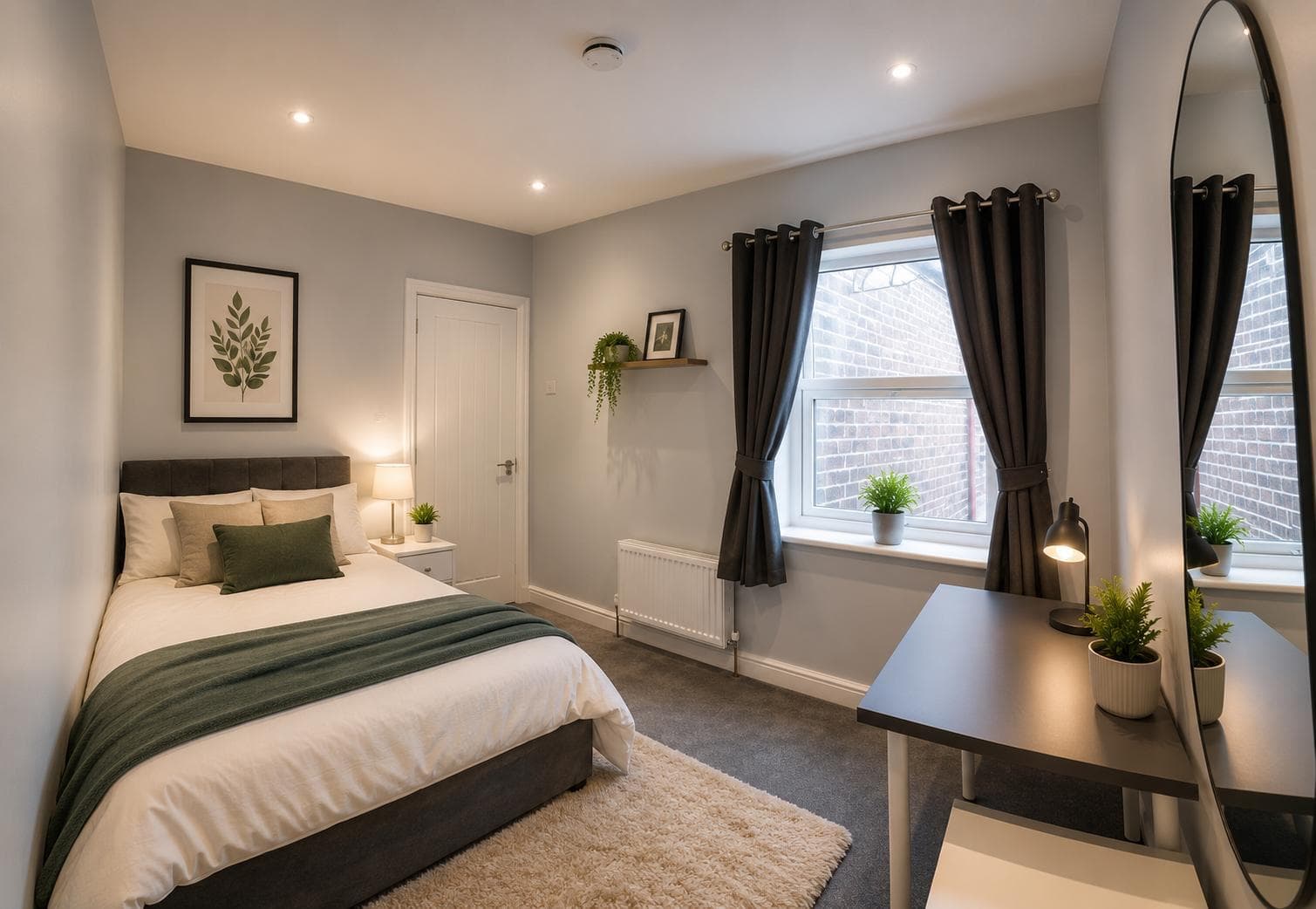
In Shelton, an all bills included shared house gets you a furnished room with a bed, desk, chair and wardrobe, a shared kitchen and living room, and gas, electricity, water and wifi inside one weekly price. Ours start at £105 per person per week.
Compare the per person per week figure, never the headline price for the house, and never a monthly figure with bills to be added later. Our guide to student bills explains what a genuine all-inclusive price covers, what it almost never covers, and the fair usage question worth asking.
One thing worth knowing early: as a full-time student you are exempt from council tax, but the exemption is not automatic. You get a certificate from the university and send it to the council. If one person in the house is not a full-time student, the house can lose the full exemption.
What to look at on a viewing
You are looking at a hundred-year-old terrace, most likely. That is fine, but look properly:
- Walk the route to campus yourself, at the time of day you would actually walk it.
- Damp in the back rooms and the corners of ceilings. Look behind wardrobes.
- Smoke alarms on every floor, and ask whether it is a licensed HMO. A landlord who looks after their houses will show you the licence.
- How many people share each bathroom.
- Whether the wifi is already installed and working, and what speed it gets.
- The smallest bedroom. Somebody has to live in it, and if it is close to the legal minimum you want to know before you draw straws.
Ask who you call when something breaks, and how quickly they come. Renting direct from the landlord makes that answer a lot shorter than renting through an agency.
Before you sign
Get the important things in writing rather than in a conversation: which bills are included, whether there is a usage cap, the tenancy dates, who is liable for what, and which government-backed scheme your deposit goes into. If you have a parent acting as guarantor, our guarantor guide explains exactly what they would be signing, which is worth reading before you ask them.
If the group falls apart
It happens more often than anyone admits. Somebody changes course, somebody goes home, somebody has a falling-out in March. What you can do about it depends almost entirely on a decision you made months earlier.
On a joint tenancy, the remaining housemates are liable for the empty room. The rent for the whole house is owed by all of you, so if one person stops paying, the rest of you cover it, and their guarantor and yours are all in scope. You can usually find a replacement, but the landlord has to agree to them and everybody has to re-sign.
On individual room agreements, one person leaving is the landlord's problem to re-let, not yours. This is the single strongest argument for asking about tenancy structure before you sign rather than after, and it is why we let per room.
Either way, tell the landlord early. A room that is empty from March and reported in March can often be re-let. A room that is empty from March and reported in June cannot.
Where we let
Most of our houses are in Shelton, minutes from the Staffordshire University campus, with the rest in Stoke town and Newcastle-under-Lyme. We are family-run, we manage the houses ourselves, and there are no admin fees and no advance deposit.
The Staffordshire University page shows what is currently free within walking distance of campus, and our guide to living in Shelton covers the area itself in more detail.